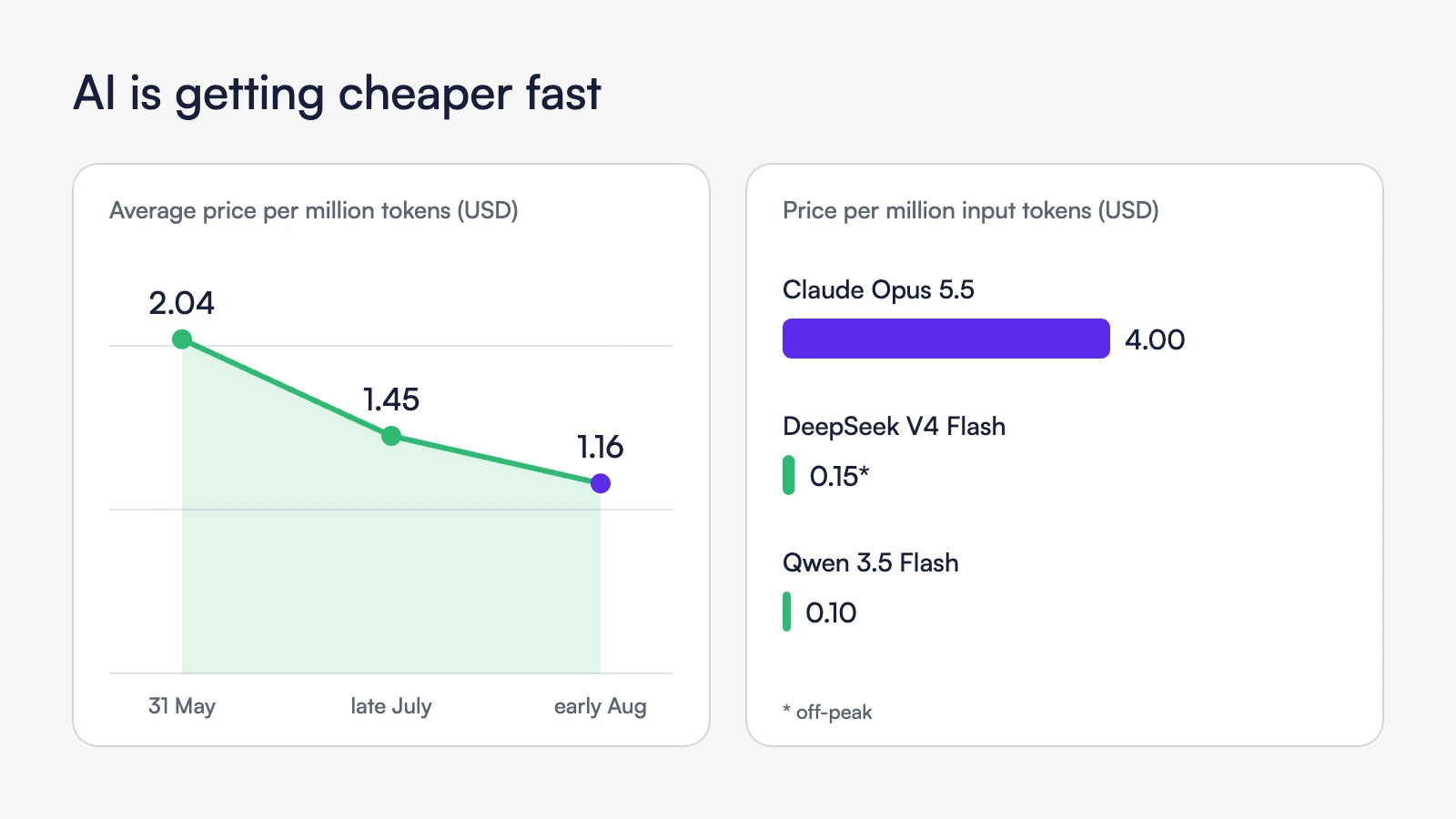
For companies using AI today, only one thing counts: will what you are building now still work and still pay off when the market turns? That turn can go two ways. Prices can rise when the subsidy stops, but they can also fall further, and then you pay too much if you are locked in to one vendor. On the other hand, models can disappear quickly. Opus 5 was replaced after just two months. If you build your application around one specific model, you are building on sand.
An architecture that absorbs this has a few fixed characteristics:
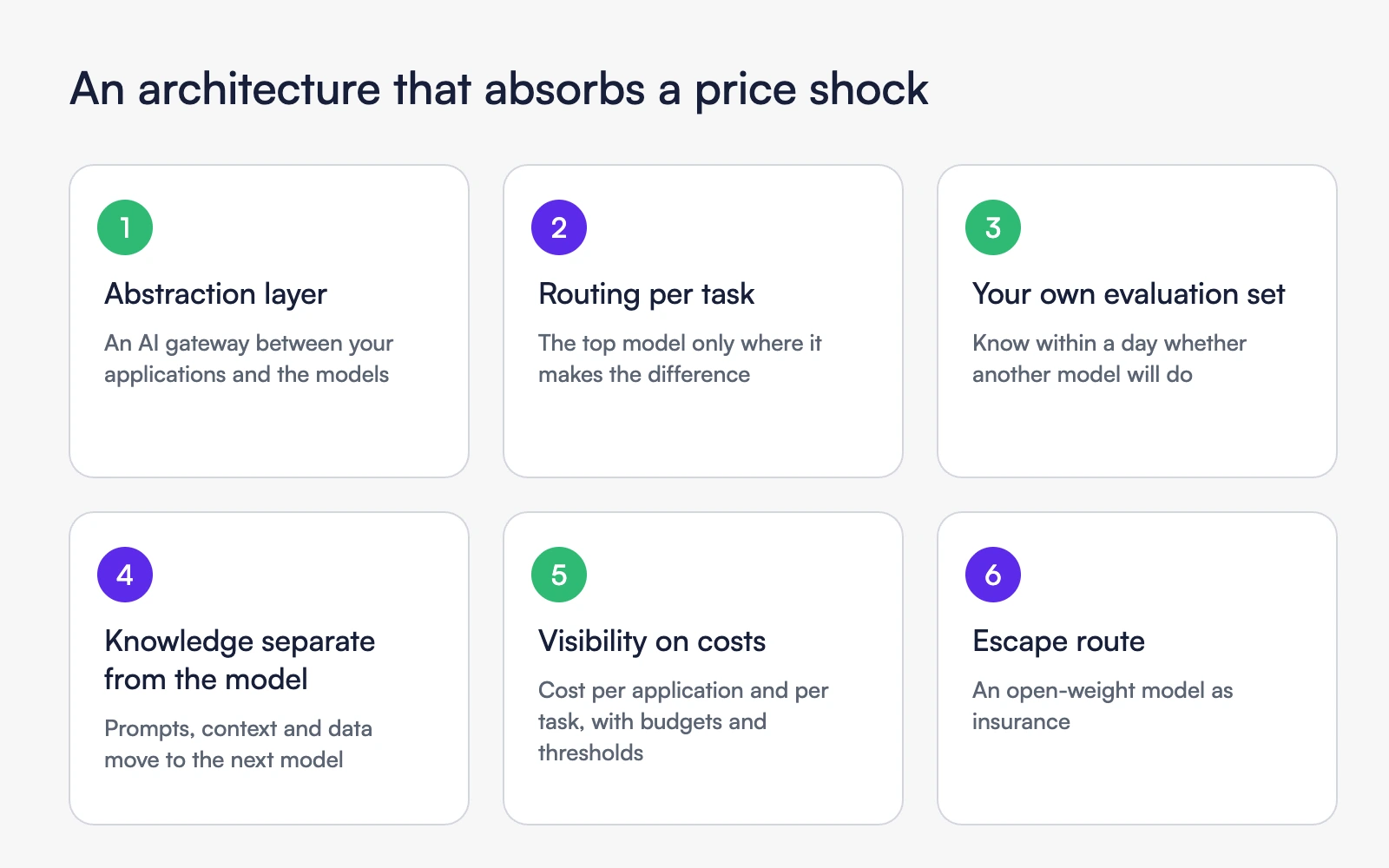
First, there is an abstraction layer between your applications and the models. That can be an AI gateway that receives every call and forwards it to the model you have chosen. Within the Microsoft ecosystem, you can do this with the AI gateway capabilities of Azure API Management, for example, while Azure AI Foundry brings together models from different vendors. Switching models then becomes a configuration choice, without having to rebuild everything. Use vendor-specific features deliberately. Document them, so you know what to replace when the time comes.
Second, you route per task. You only need a top model for part of your requests. A classification or a summary runs fine on a model that is twenty times cheaper. You reserve the top model for the work that makes the difference. That is often where the biggest savings are, bigger than any price cut delivers.
Third, you have your own evaluation set. A set of representative tasks with expected outcomes lets you decide within a day whether a new or cheaper model is good enough. Without such a set, every model switch remains a gamble, and then you do not switch.
Fourth, your knowledge stays yours: your prompts, your context, your documentation and your data. They have to be separate from the model, so they move along to the next one.
Fifth, you keep a warning light on your running costs. Measure your costs per application, per customer and per completed task, and not just per token. Set budgets and thresholds, so you spot a runaway process or an agent stuck in a loop after an hour, and not only on the monthly invoice. What you do not measure, you cannot steer, and with consumption-based pricing the invoice quietly rises along with it.
Finally, you have an escape route. An open-weight model that you host yourself or place with a European partner covers part of your applications and serves as insurance against a price shock or a vendor changing its terms. It also helps for data that is not allowed to leave Europe.
In fact, this is all familiar ground. It is the same discipline we learned with the cloud twenty years ago: do not become dependent on one party, measure what you consume and make sure you can leave. With AI it just goes faster, and prices shift a little harder.

:focal())