Beltug, the association of Belgian digital leaders, asked more than 300 CIOs and ICT decision-makers what tops their agenda. This year, AI stands head and shoulders above the rest. We list the key findings, along with what we see in practice.

:focal())
What does the Priorities Compass 2026 say?
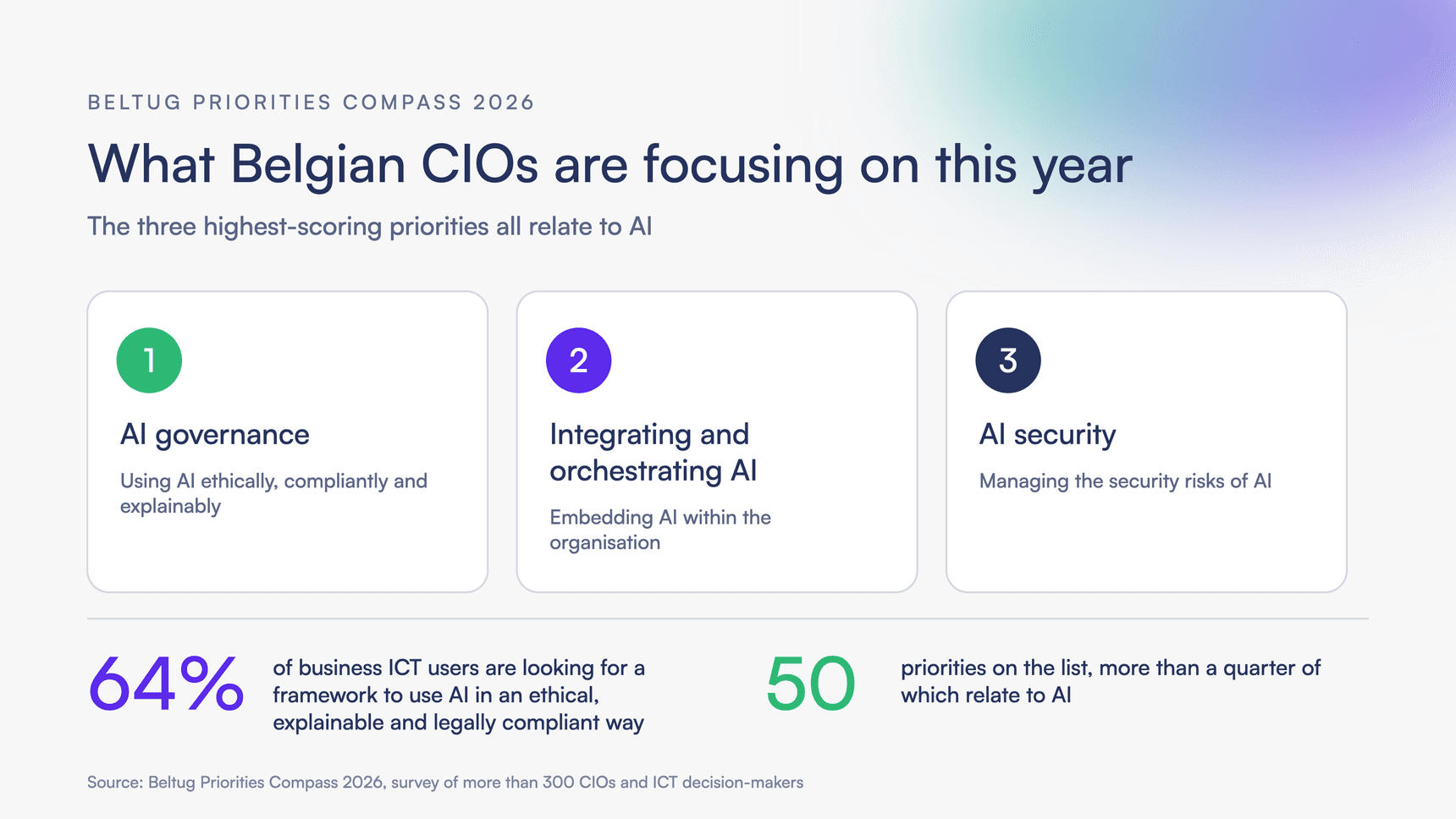
The respondents come from companies, government services, universities and hospitals. Of their 50 priorities, more than a quarter relate to AI. The three highest-scoring priorities all have a link with AI:
AI governance: using AI ethically, compliantly and explainably
Integrating and orchestrating AI within the organisation
Managing the security risks of AI
64% of business ICT users are looking for a framework to use AI in an ethical, explainable and legally compliant way. Beltug sees organisations moving from pilot projects to a strategic AI policy. IT governance towards the board also scores high, as does resilience. CIOs are also taking a more critical look at their digital dependencies. And HR and ICT are working more closely together: CIOs increasingly involve HR in the impact of AI on employees and their skills.
You can read the full overview in Beltug's article (in Dutch).
AI is already in your organisation
These priorities are about AI that is already in use today. Your colleagues write their emails with Copilot and summarise documents with ChatGPT, usually long before a policy is on paper. So the question is how to steer that use in the right direction without dampening your people's enthusiasm. Below, we look at the three top priorities and at the collaboration between HR and ICT.
AI governance: start with what is in use today
Writing an AI policy is the easiest step. The hard part is knowing which AI tools your people actually use and which company data ends up in them. Map that first. Then decide, per type of data, what is allowed in an AI tool: customer data and personnel files call for stricter rules than a text for your website. Also define who owns each application and who decides on new tools.
Keep the policy short and write it in language your employees understand. Two pages that everyone reads have more effect than a hefty document that stays in a drawer.
Integrating and scaling AI: calculate the cost upfront
A pilot with twenty users asks little. An application for the whole organisation has to connect to your existing systems, and token costs add up every day. If you only look at that after the rollout, you get an invoice nobody had anticipated. So already during the pilot, ask what the application will cost at full use, and agree on how you will measure that use.
That question sometimes determines the technical choice as well. At a manufacturing SME that wanted to detect seam defects, a small device next to the production line processes the camera images itself. The images do not have to go to the cloud first, which keeps costs low and avoids delays in production. Before the system took over the inspection, it ran in parallel with the operators for two weeks.
AI security: make visible what is happening
You can only secure what you can see. Every AI tool that employees use on their own initiative is a place where sensitive data can leave your organisation. So start with visibility: which AI apps are in use, and what data do they get to see? Then decide which tools you allow.
Offer your people a secure tool before you ban anything. People who get what they need will not go looking for it themselves.
HR and ICT: bring your people along
We see it as a good sign that CIOs are sitting down with HR more often. An AI tool only has an effect when your people know when and how to use it, and that question differs per role. A sales representative needs different examples than an accountant. Since February 2025, the AI Act also requires organisations to bring the AI literacy of their employees up to standard.
At Maxeda DIY Group we saw what that looks like in practice. The learning programme had three levels, so that colleagues with less digital experience could also join. The workshops ran in three languages, and anyone who wanted personal guidance could turn to a dedicated coach.
To conclude
The message of the Priorities Compass is clear: AI is present in your organisation and the work now lies in keeping it under control. Those who have visibility of its use, know the costs and bring their people along get the most out of it.
Want to talk about this further? On 24 November, AI security and employee adoption are on the agenda at our AI event, along with the question of how to put AI into production in a manageable way. View the AI Reality Check programme.